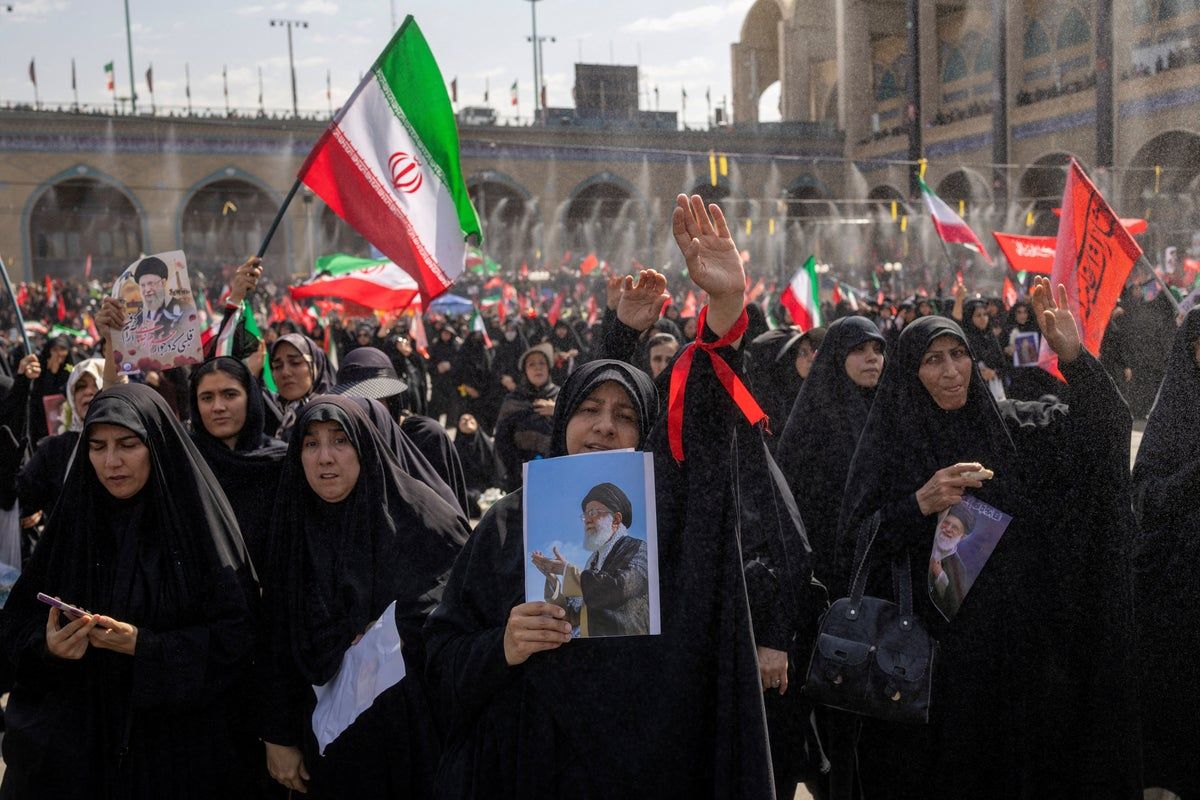
Mourners Chant for Revenge at Start of Iran Leader's Funeral
Millions are expected to attend the dayslong funeral of Ayatollah Ali Khamenei, Iran's slain leader, which began in Tehran on Monday. The flag-draped casket of the prominent cleric was put on display as large crowds gathered, a somber spectacle underscoring the profound impact of his passing on the Islamic Republic and the wider region.
Chants for revenge echoed through the streets as mourners expressed their grief and anger, a visceral reaction that signals the deep-seated animosity towards those perceived as responsible for Khamenei's death. The funeral proceedings underscore the significant regional political tensions following Khamenei's demise, a development that has sent ripples of uncertainty across the Middle East.
"The streets were filled with people chanting for vengeance," said one attendee who wished to remain anonymous due to security concerns. "There is a palpable sense of loss, but also a burning desire for retribution. Khamenei was a symbol for many, and his assassination is seen as an attack on the very heart of the nation."
Ayatollah Khamenei, who was 85 years old, held significant influence within Iran's political and religious establishment for decades. As the Supreme Leader, he was the ultimate authority on state matters, wielding considerable power over government policies, the judiciary, and the military. His death marks a pivotal moment for the nation and its role in the Middle East, ushering in an era of transition and potential instability.
The funeral is scheduled to continue for several days, with various ceremonies planned across the capital. These events are not merely expressions of mourning but also serve as a crucial platform for the regime to project an image of unity and strength in the face of adversity. Security measures have been significantly heightened throughout Tehran, with a visible presence of security forces aimed at maintaining order and preventing any potential disruptions. The scale of the security operation reflects the government's awareness of the heightened emotions and the potential for unrest.
Khamenei's tenure as Supreme Leader, beginning in 1989, was characterized by a firm stance against Western influence and a commitment to the principles of the Islamic Revolution. He oversaw Iran's foreign policy, its nuclear program, and its complex network of alliances and proxy forces across the region. His death leaves a void in the country's leadership that will be difficult to fill, raising questions about the future direction of Iran's domestic and foreign policies.
The immediate aftermath of Khamenei's assassination, which has been officially attributed by Iranian authorities to "external hostile elements," has already seen a surge in anti-Western rhetoric. The government has vowed a swift and decisive response, further escalating tensions with several Western nations and regional rivals. International observers are closely monitoring the situation, concerned about the potential for retaliatory actions that could destabilize an already volatile region.
The succession process for the Supreme Leader is a critical element that will shape Iran's future. While the Assembly of Experts, a body of senior clerics, is tasked with selecting Khamenei's successor, the process is often opaque and influenced by internal power dynamics. Speculation is rife about potential candidates, including Khamenei's son, Ahmad, and other prominent figures within the clerical hierarchy. The choice of the next Supreme Leader will have profound implications for Iran's internal politics and its engagement with the international community.
The days of mourning and the elaborate funeral ceremonies will also serve as a critical test for the current administration, led by President Ebrahim Raisi. The government will need to manage public grief, maintain internal stability, and project an image of control to both its domestic population and the international stage. The economic implications of this leadership transition are also a significant concern, as Iran continues to grapple with international sanctions and internal economic challenges.
The regional implications are perhaps the most significant. Khamenei was a key architect of Iran's regional policy, supporting groups like Hezbollah in Lebanon, Hamas in Gaza, and various militias in Iraq and Syria. His death could lead to a reassessment of these alliances and a shift in the balance of power in the Middle East. Rivals like Saudi Arabia and Israel, who have long viewed Iran's regional influence with alarm, will be watching closely for any signs of weakness or change in Iranian policy.
As the funeral procession continues, the chants for revenge serve as a stark reminder of the deep emotions and political currents at play. The coming days and weeks will be crucial in determining the trajectory of Iran's leadership, its domestic stability, and its role in a region already fraught with conflict and uncertainty. The world watches, holding its breath, as Iran navigates this profound moment of transition.