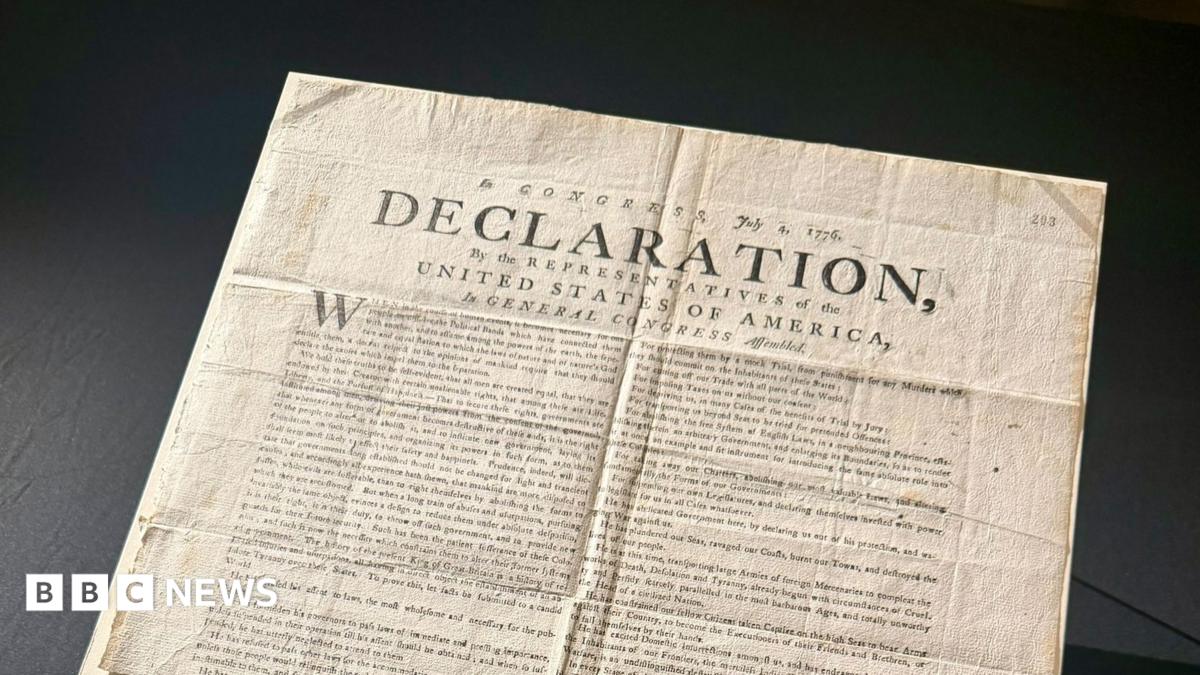
Rare Copy of Declaration of Independence Discovered in London
A volunteer cataloging naval correspondence in London has uncovered a remarkably preserved copy of the Declaration of Independence. The document, printed approximately 250 years ago in New Hampshire, was found among historical naval letters.
The discovery is being hailed as a significant historical find, with experts describing such copies as "vanishingly rare." The volunteer described the moment of discovery as "thrilling."
The artifact offers a tangible link to a pivotal moment in American history, preserved across the Atlantic. The specific printer and exact date of this New Hampshire printing are now subjects of further historical investigation.
An Unlikely Repository for a Foundational Text
The discovery of this 18th-century American foundational document within a collection of British naval letters might seem, at first glance, incongruous. However, historical context suggests a plausible, albeit indirect, connection. During the American Revolutionary War, British naval operations were extensive, and correspondence between ships, admirals, and the Admiralty in London was constant and voluminous. It is conceivable that a printed copy of the Declaration, perhaps captured as a piece of intelligence, sent by a sympathizer, or even acquired through less direct means, found its way into this stream of official communication.
The fact that the document originated in New Hampshire is particularly noteworthy. While the Declaration was adopted by the Continental Congress in Philadelphia in July 1776, its dissemination across the thirteen colonies, and beyond, was a crucial undertaking. Printers were tasked with producing copies for public display and distribution. New Hampshire, as one of the original colonies, would have had its own printing operations producing these vital documents. The survival of a copy printed in that specific colony, and now found in London, adds another layer to the narrative of its initial spread and the far-reaching impact of the revolutionary ideals it espoused.
The Rarity and Significance of Early Printings
The description of this copy as "vanishingly rare" underscores the fragility of historical documents and the challenges of their preservation over centuries. Unlike official government archives, which are often more systematically managed, personal correspondence and miscellaneous papers are more susceptible to loss, damage, or being overlooked. The survival of any early printed copy of the Declaration is an event of considerable historical importance. Many were likely destroyed during the war, either through conflict, neglect, or deliberate suppression by Loyalists.
Early printings of the Declaration are invaluable to historians for several reasons. They provide evidence of how the text was disseminated and received in different regions. Variations in printing, typefaces, and paper can offer clues about the specific printing houses involved and the logistical challenges of producing and distributing such a significant document across a nascent nation at war. Furthermore, these surviving copies serve as tangible reminders of the courage and conviction of those who risked everything for the cause of independence.
The Volunteer's Thrilling Discovery
The narrative of a volunteer making such a monumental find adds a human element to the historical discovery. Cataloging vast archives can be a painstaking and often monotonous task, involving sifting through countless documents that may appear, on the surface, to be of little consequence. The volunteer's description of the moment as "thrilling" speaks to the profound impact of encountering a piece of history that has shaped the modern world. Such discoveries often occur when individuals dedicate their time and passion to preserving and understanding the past, unearthing treasures that might otherwise remain hidden.
This particular find highlights the importance of volunteer efforts in archival institutions. Many archives rely heavily on the dedication of individuals who contribute their expertise and time to make collections accessible and to identify items of significance. Without such efforts, many historical documents could languish in obscurity, their stories untold.
Next Steps: Authentication and Historical Context
The immediate next steps following such a discovery involve rigorous authentication and scholarly examination. Experts in early American printing, paleography, and the history of the Declaration of Independence will undoubtedly be eager to study the document. This will include analyzing the paper, ink, typeface, and any watermarks to confirm its age and origin. Determining the exact printer and the precise date of printing in New Hampshire will be a key focus, potentially shedding new light on the printing infrastructure and distribution networks of the revolutionary era.
Researchers will also seek to understand how this particular copy ended up in a collection of British naval correspondence. Was it captured? Was it a diplomatic item? Was it a personal item of an individual associated with the British navy? The provenance of the document—its history of ownership and location—will be crucial in piecing together its journey across the Atlantic. This meticulous research will not only validate the find but also enrich our understanding of the complex interactions between Great Britain and its former colonies during and in the immediate aftermath of the Revolution.
The implications of this discovery extend beyond mere historical curiosity. It serves as a powerful reminder of the enduring legacy of the Declaration of Independence and its global significance. The fact that a copy printed in a New Hampshire print shop in the 1770s has survived, crossed the ocean, and been rediscovered in a London archive, speaks to the profound impact of the ideas it contains and the ongoing fascination with this pivotal document in the story of American nationhood.