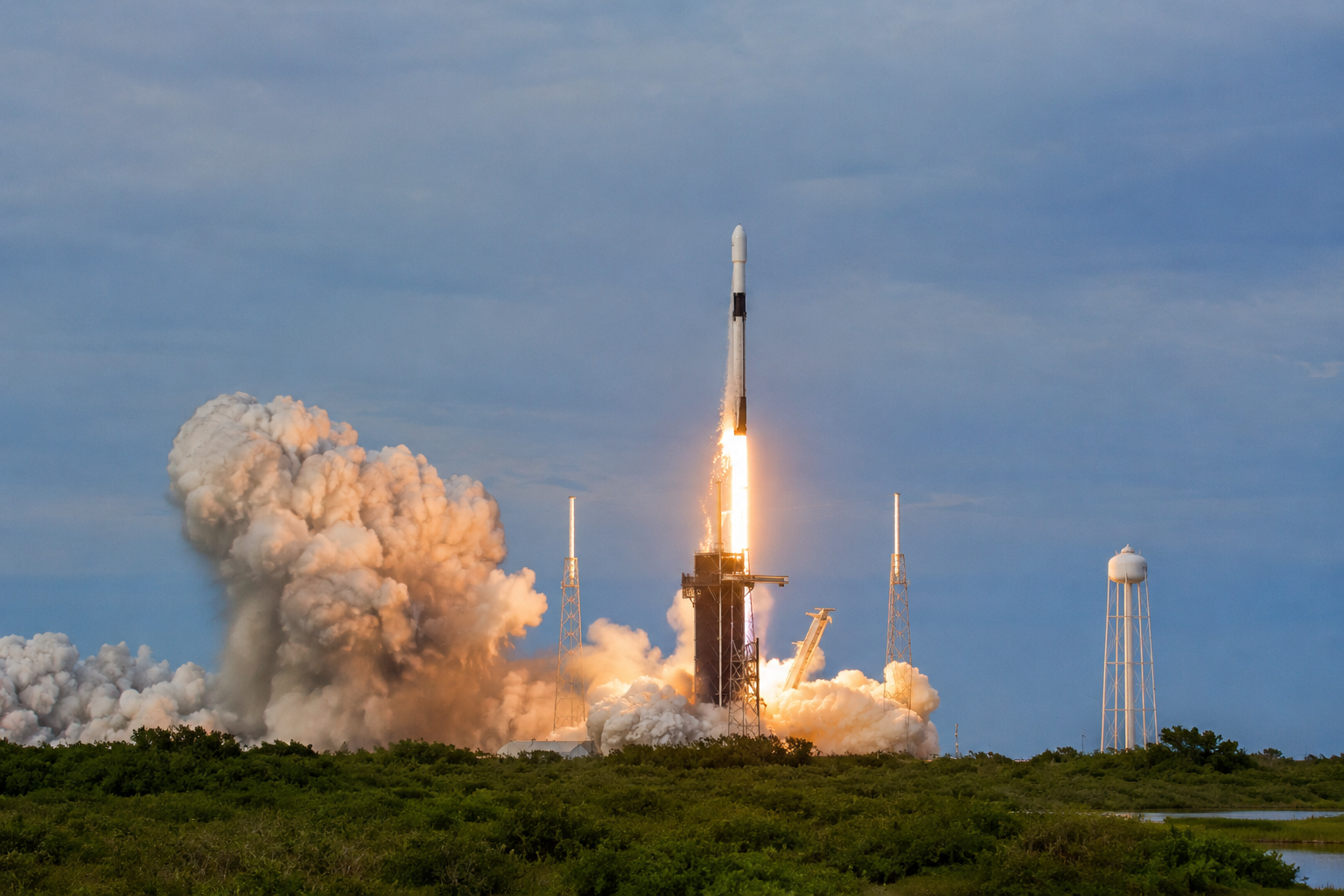
SpaceX Surpasses Amazon in Market Valuation, Briefly Joins Elite U.S. Companies
SpaceX has achieved a significant milestone, surpassing Amazon's market capitalization. This valuation surge, driven by a recent funding round and optimistic projections for its ambitious Starship program, briefly placed the private aerospace manufacturer among the ranks of the largest publicly traded companies in the United States. The company's private valuation, though not publicly traded in the traditional sense, is closely watched and serves as a benchmark for its immense growth and investor confidence.
The company's increased valuation comes as CEO Elon Musk indicated ambitious future growth. Musk stated Sunday that SpaceX could potentially achieve approximately $1 trillion in revenue by 2030. This bold projection, shared on social media platform X, reflects the company's strategic vision centered on the mass production and deployment of its Starship spacecraft, designed for interplanetary travel and global point-to-point transportation on Earth. Analysts suggest that achieving such a revenue figure would require not only successful Starship operations but also significant expansion into satellite internet services via its Starlink constellation and potential government contracts for lunar and Martian missions.
This development highlights SpaceX's rapid ascent in the corporate landscape. The company's valuation now exceeds that of Amazon, a testament to its expanding influence and perceived future potential. While Amazon, a publicly traded behemoth, has a market capitalization that fluctuates daily based on stock performance, SpaceX's valuation is determined through private funding rounds. The most recent reports indicate SpaceX's valuation has reached approximately $180 billion, a figure that eclipses Amazon's current market cap of around $175 billion as of recent market close. This comparison, however, should be viewed with nuance, as Amazon's valuation is a real-time reflection of public market sentiment, whereas SpaceX's is based on discrete investment events.
For a period, SpaceX's market cap positioned it in close competition with tech giants like Microsoft. This brief inclusion among the top U.S. companies underscores its growing economic significance. At its peak valuation, SpaceX's private market cap would have placed it within the top 10 largest companies in the U.S., a remarkable feat for a company that is still privately held and has yet to turn a consistent profit. This places it in proximity to companies like Meta Platforms (Facebook) and even briefly ahead of established giants like Tesla, another Musk-led company, depending on daily market fluctuations. The sheer speed at which SpaceX has reached this valuation is unprecedented in the aerospace and technology sectors.
SpaceX's valuation was last reported to be $180 billion. This figure was established during its latest funding round, which saw significant investment from various venture capital firms and institutional investors eager to capitalize on the company's groundbreaking work in reusable rocket technology and its ambitious plans for space exploration and commercialization. The success of its Falcon 9 and Falcon Heavy rockets, coupled with the ongoing development of Starship, has instilled immense confidence in the market. Starlink, SpaceX's satellite internet service, is also a significant contributor to its valuation, with a rapidly growing subscriber base and expanding global coverage.
The implications of SpaceX's soaring valuation are far-reaching. It signals a paradigm shift in how the aerospace industry is perceived, moving from a government-dominated sector to one ripe for private innovation and commercial enterprise. Investors are betting heavily on the long-term viability of space-based economies, including satellite services, space tourism, and resource extraction. SpaceX's success validates this thesis and is likely to spur further investment in emerging space companies.
Looking ahead, the $1 trillion revenue target for 2030, if realized, would position SpaceX as one of the largest revenue-generating companies globally, surpassing many established Fortune 500 corporations. Achieving this would necessitate the successful deployment of Starship for regular cargo and crewed missions to orbit, the Moon, and eventually Mars. It would also require Starlink to become a dominant force in global internet connectivity, potentially serving billions of users. Furthermore, SpaceX's role in NASA's Artemis program, aiming to return humans to the Moon, and its potential involvement in future Mars missions, represent significant revenue streams and technological advancements.
The competitive landscape is also evolving. SpaceX's dominance in the launch market, driven by its cost-effective reusable rockets, has pressured traditional aerospace players. Its advancements in Starship technology could further disrupt the industry, offering capabilities previously considered science fiction. While Amazon, through its Kuiper project, is also investing heavily in satellite internet, SpaceX's head start and integrated launch capabilities give it a distinct advantage. The brief surpassing of Amazon's market cap is a symbolic moment, highlighting the disruptive power of SpaceX and its potential to redefine multiple industries, from transportation and communication to space exploration itself.