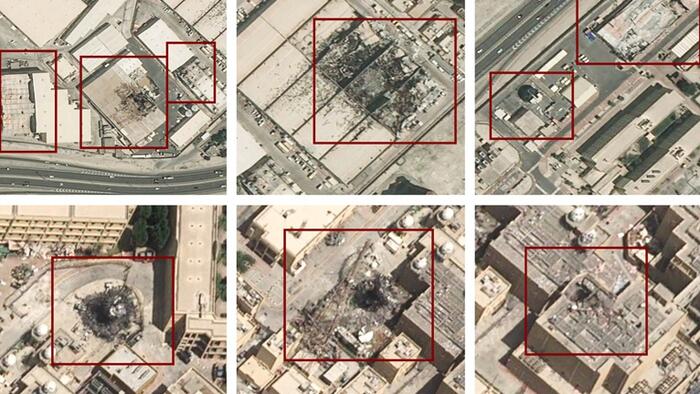
Iranian Drones Strike Bahrain Following U.S. Retaliation
Bahrain has reported being targeted by Iranian drones in the aftermath of retaliatory strikes conducted by the United States against Iran. The U.S. action followed an earlier incident where Iranian forces attacked a cargo vessel in the Strait of Hormuz, a vital maritime artery for global commerce and energy transit.
Details regarding the extent of the drone attacks in Bahrain and any potential casualties or damage remain limited, with authorities in Manama and Washington working to ascertain the full scope of the incident. Officials are actively assessing the situation and its broader implications for regional stability, which has been increasingly precarious in recent months.
The U.S. strikes were a direct response to Iran's actions against commercial shipping, which Washington has characterized as a blatant violation of international law and a threat to global maritime security. This escalation marks a significant development in the ongoing, and often volatile, tensions between the two nations, which have been exacerbated by a complex web of geopolitical rivalries and regional proxy conflicts.
The U.S. stated its strikes were intended to deter further Iranian aggression in vital international waterways. Admiral John Kirby, spokesperson for the Pentagon, emphasized that the military action was a calibrated response designed to degrade Iran's capacity to launch similar attacks and to send an unequivocal message that such provocations would not be tolerated. "Our objective is to de-escalate, but also to ensure freedom of navigation and the safety of international shipping," Kirby stated in a press briefing.
The Strait of Hormuz, a narrow waterway connecting the Persian Gulf to the open ocean, is a critical chokepoint for global oil supply, with approximately one-fifth of the world's oil consumption passing through it daily. Recent incidents, including the attack on the cargo vessel, have raised significant concerns about potential disruptions to maritime traffic, which could have far-reaching economic consequences worldwide. The international community, particularly major oil-importing nations, watches these developments with considerable apprehension.
Bahrain, a close U.S. ally situated in the heart of the Persian Gulf and hosting a significant U.S. naval base, has been drawn directly into the escalating conflict. The drone attacks represent a new and concerning dimension to the regional confrontations, suggesting a potential broadening of Iran's retaliatory or deterrent strategies beyond direct attacks on shipping or military assets. This move could be interpreted as an attempt to pressure U.S. allies in the region and to demonstrate a wider reach of Iranian capabilities.
The U.S. Department of Defense confirmed its strikes were precise and aimed at specific Iranian targets, including missile launch sites and drone facilities, believed to be involved in planning and executing attacks on shipping. Further details on the objectives and outcomes of these strikes are expected to be released as intelligence assessments are finalized. The Pentagon has indicated that it is prepared to take further action if necessary to protect U.S. interests and its allies in the region.
The latest developments underscore the volatile security environment in the Middle East, a region long characterized by complex political dynamics and intermittent conflict. International observers, including the United Nations and various foreign ministries, are closely monitoring the situation for any further escalation, urging restraint from all parties involved. Diplomatic channels are reportedly active behind the scenes, though public statements have remained firm.
The U.S. has maintained a significant military presence in the region, including naval fleets and air power, to ensure freedom of navigation and to deter potential aggressors. This presence is often cited as a cornerstone of regional security architecture, but the recent events highlight the persistent challenges in maintaining stability amidst heightened tensions. The strategic implications of these drone attacks on Bahrain are significant, potentially altering the risk calculus for regional actors and increasing the likelihood of miscalculation.
Analysts suggest that Iran's alleged involvement in the Bahraini drone incident, if confirmed, could signal a strategic shift. Previously, Iran's maritime provocations have primarily targeted vessels in international waters or its immediate vicinity. Directing drones towards a sovereign nation that hosts a key U.S. military installation could be an attempt to demonstrate a more assertive posture and to inflict a psychological impact, signaling that no U.S. ally in the Gulf is immune from retaliation. This could also be an effort to draw the U.S. into a more direct confrontation, a scenario that both sides have, until now, sought to avoid.
The international community's response will be crucial in the coming days. Calls for de-escalation and adherence to international maritime law are likely to intensify. However, the immediate focus will be on gathering concrete evidence regarding the Bahraini incident and the U.S. response, as well as understanding the motivations behind Iran's alleged actions. The potential for a wider regional conflict, involving proxies and further direct confrontations, remains a significant concern, with ripple effects that could impact global energy markets and international security.
The long-standing tensions between the U.S. and Iran have been further complicated by Iran's nuclear program and its support for various regional militant groups. These underlying issues contribute to the persistent instability in the Middle East, making incidents like the Strait of Hormuz attack and the subsequent drone targeting of Bahrain highly combustible. The international community faces the difficult task of navigating these complex dynamics while striving to prevent a full-blown conflict.